
Wheaton Previous Resident Sources
No single roll spans the life of a Wheaton property. Current parcel data supplies the PIN, or parcel identification number, and legal description needed to follow title. The DuPage County Recorder then carries the modern deed sequence. Older ownership calls for the Recorder’s in-person grantor and grantee books, while the Wheaton Public Library collections add names of people listed at an address. Permits, maps, and newspapers explain changes that a deed alone cannot.
| Source | Years It Covers | Where Held | What It Shows |
|---|---|---|---|
| Recorder index and images | March 16, 1961 to present | DuPage County Recorder online and in Wheaton | Parties, instruments, dates, legal descriptions |
| Haines criss-cross directories | 1988–2021 and 2004–2021 runs | Wheaton Public Library | Address-to-name historical listings |
| Telephone and city directories | 1915–16; 1924–25; 1940/1950; telephone 1951–2016 | Library and digitized copies | Listed households, work, phones, addresses |
| Census schedules | Selected print and microfilm years, 1840–1930 | Wheaton Public Library | Households, ages, work, ward or township |
| City building files | Approximately 1955 onward | City FOIA and permit route | Work, plans, applicants, and alteration dates |
Choose by both date and relationship. For title after 1961, start online with the parcel and Recorder. For past residents who may not have held title, use a directory nearest the target year, then test the result against a census, newspaper, or another edition. For an early property, the legal description is more durable than the street number. A listing proves only that the source associated a name with the place on that date.
Start Wheaton House History Locally
The City’s Researching Your Home route points researchers to a Home History Research File at Wheaton Public Library, deeds, historic tax records, permits, architectural plans, census material, and maps. The library is at 225 N Cross Street and offers specialist help by appointment or at the desk. Its Genealogy Center is locked and non-circulating, so call 630-668-1374 or write genealogy@wheatonlibrary.org before expecting remote access.
Bring the current address, PIN, any retired street number, and a rough date. Staff can steer a search toward the correct directory run, newspaper title, microfilm reel, vertical file, or map. The City guide also describes short Home History Research Help sessions. If the file is thin, ask the DuPage Historical Museum about maps, platbooks, organization records, photographs, oral histories, and 1950s–70s real-estate files. Museum help is available online, by mail, or at the front desk and may take up to two weeks.
Trace Wheaton Owners Backward
Use the DuPage County Property Lookup to identify the present parcel, then use the Recorder document search to walk back through title. Keep owner and billing fields separate from occupancy. The tax roll can identify a party linked to the parcel, but it does not prove who slept there. A deed establishes a title relationship, not every member of a household.
- Copy the current PIN, situs address, municipality, and legal description from the assessor record.
- Find the current owner’s acquisition instrument by PIN, street, name, document type, or date.
- Copy the grantor, grantee, recording date, document number, and predecessor reference from the result or image.
- Search the seller as a prior grantee, while matching the legal description and instrument chain.
- At the March 16, 1961 online boundary, call the Recorder research line at 630-407-5401 or use the in-person books.
- Grantor and grantee
- The grantor transfers an interest; the grantee receives it.
- Chain of title
- The linked series of recorded transfers for the same land.
- Legal description
- The formal land description in a deed. It can survive a street-number change.
Wheaton’s Split Records Clock
Two local dates are easy to blend by mistake. Recorder documents and images begin online on March 16, 1961. DuPage GIS archival images, cited by the City guide, begin in 1956. The earlier aerial coverage does not mean deeds are online for the same years. It shows how a parcel or building looked, while the Recorder’s index documents legal instruments.
Before 1961, take the PIN and legal description to the Recorder’s grantor and grantee indexes in person. IRAD’s recorder-series descriptions explain common historical fields such as instrument type, execution date, filing date, book and page, and consideration. They orient the search but do not replace the DuPage record. Keep a gap ledger with the last online date checked, the next book or repository, and whether the next step is a visit, appointment, FOIA request, or copy order.
Note: An aerial image can show a changed roof or lot shape, but only the deed lane supports a title claim.
Old Wheaton Numbers Still Matter
A current address can fail in an old source even when the building was present. Wheaton’s guide lists dated maps and aerials from 1851 through 1987, plus the later GIS image run. The Sanborn Maps: Illinois database covers 1867–1970 and can show present and previous building numbers, block layout, use, and footprint. Pair each map with its date. A Sanborn sheet is physical evidence, not proof of ownership.
Recent City notices show that number changes are not merely a distant historical issue. Notices from 2020 through 2026 cover addresses on Liberty, Hale, Wheaton, Cromwell, Town Square, Kandahar, and other streets. When previous residents disappear from a directory search, test the retired number, a street-name variant, the subdivision, and the nearest cross street. Preserve both the printed source form and the normalized modern form. Silently replacing the old address can destroy the very link needed to join a directory entry to a parcel.
Rebuild Wheaton Past Households
Previous owners are only one part of house history. Wheaton Public Library holds telephone books from 1951–2016, West Suburban Haines criss-cross directories from 1988–2021, Near West Suburban volumes from 2004–2021, and older county and city directories. These sources can connect an address with people listed there, including some occupants who never appear in the deed chain. The full runs and how to read their abbreviations belong with the Wheaton city directory collections.
Build a dated household trail instead of merging all names. Start with the nearest directory edition. Compare the address and spelling with the census year closest to it. Then search a neighboring edition to see whether the listing persists. Add newspapers, yearbooks, cemetery material, and an obituary only when each supports the same person, place, and time.
- Record the directory edition, page, printed address, and exact relationship marker.
- Check the closest available census schedule for household members and geographic context.
- Test the prior and next directory years for continuity or a number change.
- Confirm a departure or death through a dated newspaper page, obituary, cemetery record, or court file.
Lawful use. Research Wheaton previous residents for house history, genealogy, and personal curiosity. Never use a historical trail to track, harass, or harm a living person.
Newspapers Close Wheaton Gaps
A deed may show when title changed but not why a family left, who occupied a home between transfers, or when a structure changed. Wheaton Public Library’s newspaper shelf supplies those missing links. Its runs include the Wheaton Illinoian from 1885–1939, Daily Journal from 1933–94, Leader holdings from 1955–2000, and later Suburban Life and Daily Herald access. Search names, address variants, subdivision names, and nearby institutions, then inspect the page image because optical character recognition can miss print.
The Wheaton historical newspaper collection is also the source of the page shown below. It demonstrates the library’s practical routes into local notices and archives.
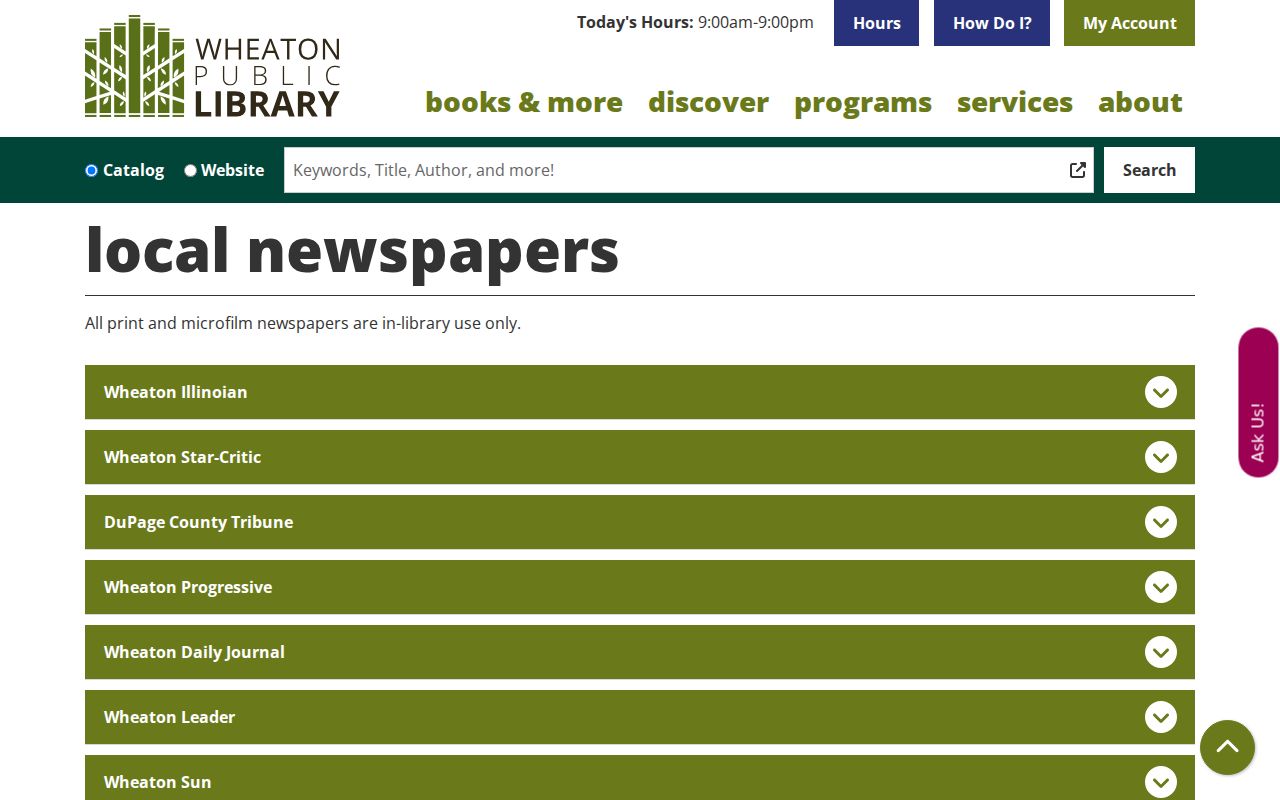
Use a notice as a dated clue, not a complete household record. Preserve the newspaper title, issue date, page, column, printed spelling, and image link. The library warns that old names, places, and dates can include errors or guesses, so verify a match with another source.
Label Wheaton Resident Evidence
The safest account of previous residents uses narrow verbs. A deed says a person granted or received an interest. An assessor record lists an owner or billing party for a tax year. A directory says someone was listed at an address. A permit names an applicant, owner, contractor, or signatory. None of those labels should be changed to “lived here” without an occupancy source.
Likewise, a gap in an online search means only that the item was not visible through that portal and query. Ask the Recorder about older books, the City Clerk about a focused FOIA request, WPL about a directory or microfilm run, and the museum about archival files. This fallback chain makes a Wheaton previous-resident history more honest and often more complete than a broad name search.
A focused City request should name the address, PIN, retired number, date range, and record class. Ask for inspection or copies and identify the department likely to hold the file. Illinois Freedom of Information Act guidance says a written request should describe specific records; it is not a substitute for restricted vital certificates or records held by another custodian. For permits, state whether the goal is a building file, inspection, plan, or address-change notice. Architectural plans may also require owner permission under the City’s house-research guidance.
Keep a source log as the Wheaton trail grows. Record the office or collection, search date, edition or document number, page, relationship label, and any spelling or address variant. If two sources conflict, show both dates and labels instead of forcing a single answer. That method lets later researchers retrace the work and keeps a clue about past residents from becoming an unsupported claim.